
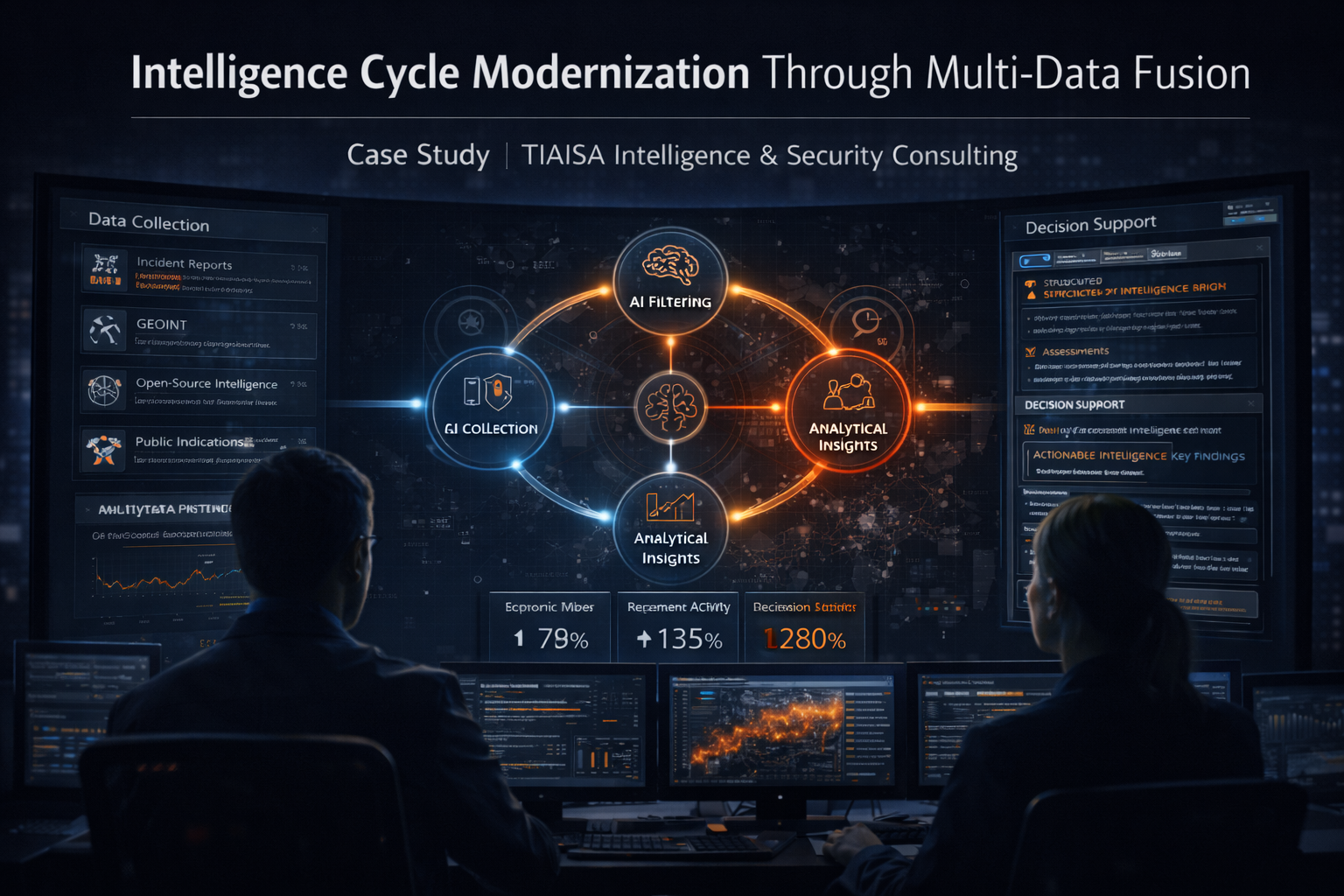
Case Study | TIAISA Intelligence & Security Consulting
Overview
Traditional intelligence cycles were designed for slower, linear threat environments. In today’s data-rich and rapidly evolving security landscape, fragmented collection, delayed analysis, and manual reporting often prevent institutions from responding effectively to emerging risks.
This case study illustrates how multi-data intelligence fusion and AI-assisted workflows can modernize the intelligence cycle—improving speed, clarity, and operational readiness without sacrificing analytical integrity.
All information in this case study is anonymised and presented for intelligence illustration only.
The Challenge
An institutional security unit faced structural limitations including:
- Slow intelligence collection-to-report timelines
- Data silos between departments
- Manual collation of intelligence inputs
- Limited real-time situational awareness
These constraints reduced leadership’s ability to act decisively.
Intelligence Objective
The objective was to redesign the intelligence cycle to:
- Accelerate collection and processing
- Integrate multiple data streams seamlessly
- Improve analytical accuracy
- Enhance briefing quality and timeliness
The framework was focused on institutional efficiency and decision support.
TIAISA Intelligence Framework Applied
TIAISA implemented a structured modernization methodology.
1. Integrated Data Collection Architecture
Collection streams were consolidated from:
- OSINT platforms
- Incident reporting systems
- Geospatial datasets
- Public risk indicators
This created a unified analytical pipeline.
2. AI-Assisted Processing & Prioritisation
Machine learning tools were used to:
- Filter high-volume data inputs
- Highlight priority signals
- Reduce analytical overload
- Support analyst focus
AI functioned as an augmentation tool, not a replacement.
3. Intelligence Fusion & Workflow Redesign
Existing intelligence processes were restructured to:
- Improve inter-unit collaboration
- Standardise analytical reporting
- Reduce duplication
- Streamline validation procedures
Human oversight remained central.
Key Findings
The modernization initiative revealed:
- Significant delays originated from manual data reconciliation
- Redundant reporting pathways reduced efficiency
- AI-supported filtering improved analytical focus
- Standardised templates enhanced leadership comprehension
These insights guided process refinement.
Deliverables Provided
TIAISA delivered institutional-grade solutions including:
- Integrated Intelligence Cycle Framework
- Workflow Optimization Models
- Standardised Briefing Templates
- Operational Readiness Dashboards
All outputs supported long-term institutional capacity building.
Strategic Impact
The modernized intelligence cycle enabled stakeholders to:
- Reduce reporting latency
- Improve situational awareness
- Strengthen cross-unit coordination
- Enhance leadership confidence in intelligence outputs
The result was greater readiness through structured integration.
Why This Matters
An effective intelligence cycle is the backbone of security governance.
Modernized intelligence systems allow institutions to:
- Process complexity efficiently
- Maintain analytical rigor
- Respond faster without compromising accuracy
- Build sustainable intelligence capacity
This case demonstrates the importance of system-level intelligence reform.
Compliance & Ethics Note
TIAISA provides analytical and advisory services only.
No operational command, enforcement, or surveillance activities were conducted.
All methodologies adhered to governance and compliance standards.
Leave a Reply