
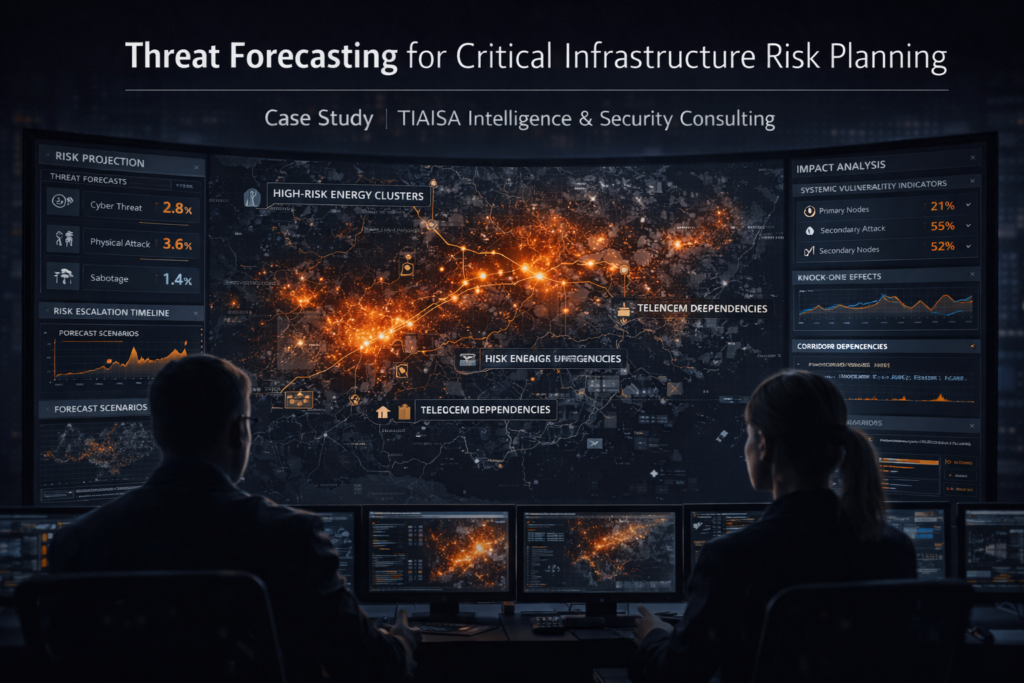
Case Study | TIAISA Intelligence & Security Consulting
Overview
Critical infrastructure—such as energy facilities, transportation networks, telecommunications systems, and logistics hubs—forms the backbone of national stability. Disruption to these assets can have cascading economic and social consequences. Traditional security approaches often focus on physical protection without sufficient emphasis on predictive risk intelligence.
This case study illustrates how AI-supported threat forecasting and intelligence fusion can enhance critical infrastructure risk planning and resilience.
All information in this case study is anonymised and presented for intelligence illustration only.
The Challenge
An institutional stakeholder responsible for infrastructure risk management faced persistent challenges including:
- Limited early-warning capability for emerging threats
- Fragmented risk assessments across departments
- Overdependence on static vulnerability audits
- Difficulty translating risk data into strategic action
As a result, risk planning remained largely reactive.
Intelligence Objective
The objective was to develop a predictive infrastructure risk assessment framework capable of:
- Forecasting emerging threat patterns
- Identifying vulnerable asset clusters
- Supporting resilience planning
- Informing leadership-level investment priorities
The framework was designed strictly for advisory and preparedness purposes.
TIAISA Intelligence Framework Applied
TIAISA implemented a structured threat forecasting methodology.
1. Multi-Layer Risk Modeling
AI models integrated:
- Historical incident records
- Environmental and geographic variables
- Operational stress indicators
- Public safety and regulatory data
This enabled holistic risk profiling.
2. Geospatial Exposure Analysis
Geospatial intelligence tools were used to:
- Map infrastructure dependencies
- Identify corridor and hub vulnerabilities
- Analyse proximity to known risk zones
This produced layered exposure assessments.
3. Intelligence Fusion & Scenario Simulation
AI outputs were contextualised through:
- OSINT indicators
- Policy environment analysis
- Human analyst review
Scenario simulations supported strategic planning without operational deployment.
Key Findings
The analysis revealed:
- Certain infrastructure nodes carried disproportionate systemic risk
- Secondary assets were often more vulnerable than primary facilities
- Environmental and logistical stress factors amplified exposure
- Preventive investment opportunities were identifiable in advance
These findings enabled targeted resilience planning.
Deliverables Provided
TIAISA delivered institutional-grade intelligence products including:
- Infrastructure Risk Forecast Reports
- Asset Vulnerability Heatmaps
- Scenario Planning Models
- Strategic Resilience Briefings
All outputs were structured for policy and planning use.
Strategic Impact
The threat forecasting framework enabled stakeholders to:
- Prioritise risk mitigation investments
- Improve continuity planning
- Strengthen emergency preparedness
- Align infrastructure policy with security intelligence
The result was greater systemic resilience.
Why This Matters
Critical infrastructure security cannot rely on protection alone.
It requires anticipation, planning, and adaptive intelligence.
Threat forecasting allows institutions to:
- Reduce systemic vulnerability
- Prevent cascading failures
- Support sustainable development
- Protect public confidence
This case demonstrates the importance of intelligence-led infrastructure resilience.
Compliance & Ethics Note
TIAISA provides analytical and advisory services only.
No surveillance, enforcement, or physical security operations were conducted.
All methodologies complied with legal, regulatory, and ethical standards.
Leave a Reply