
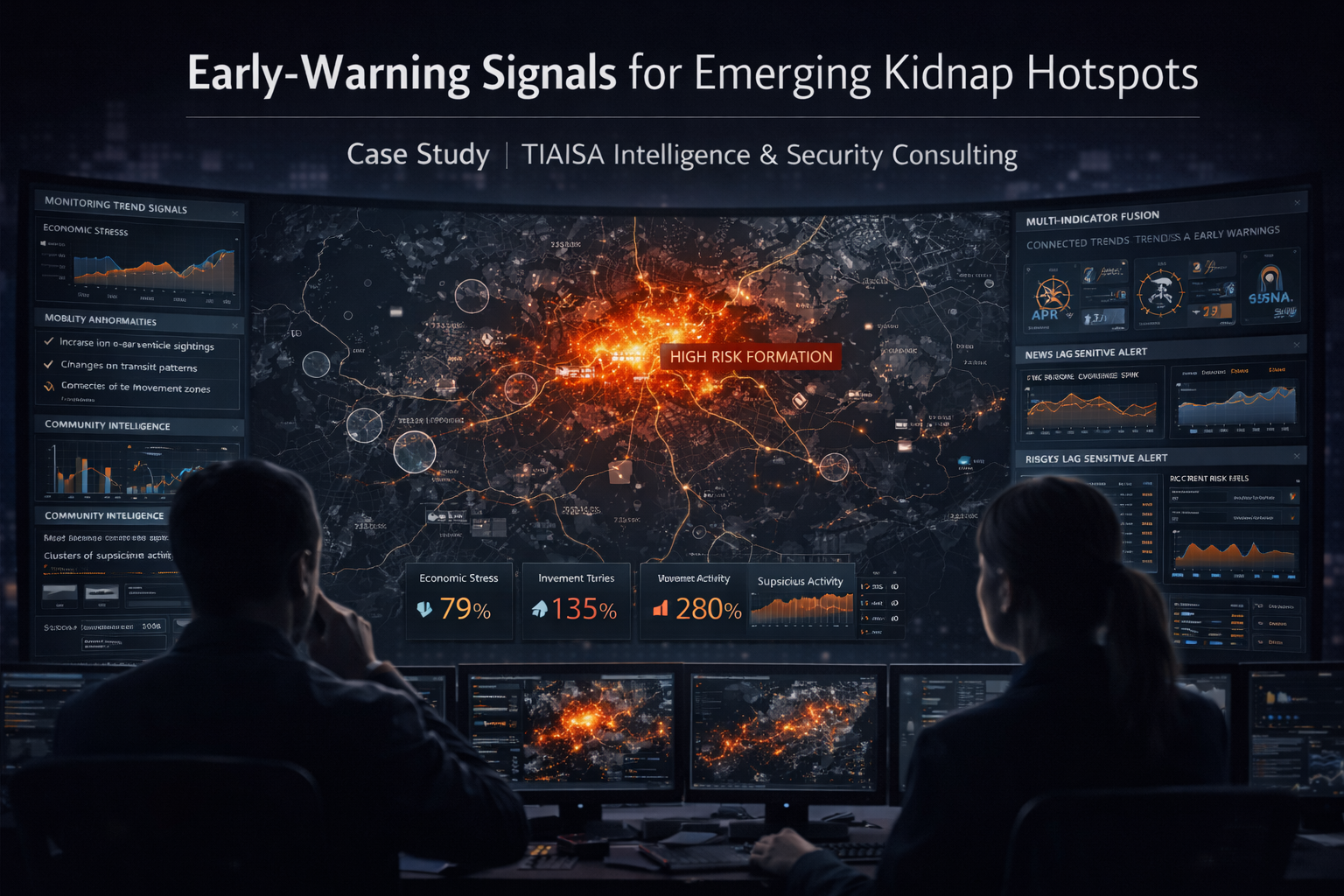
Case Study | TIAISA Intelligence & Security Consulting
Overview
Kidnapping hotspots rarely emerge suddenly. In most cases, they develop through gradual shifts in social, economic, and behavioural indicators that precede major incident clusters. Traditional security systems often detect hotspots only after incidents have escalated.
This case study illustrates how early-warning intelligence systems, powered by AI and multi-source analysis, can identify emerging kidnapping risk zones in advance—supporting proactive planning and preventive strategy.
All information in this case study is anonymised and presented for intelligence illustration only.
The Challenge
A regional security stakeholder faced increasing uncertainty related to:
- Sudden emergence of kidnapping clusters
- Limited visibility into early-stage risk signals
- Delayed recognition of hotspot formation
- Fragmented reporting across agencies
By the time official alerts were issued, risk levels were already elevated.
Intelligence Objective
The objective was to develop an early-warning analytical framework capable of:
- Detecting preliminary risk indicators
- Identifying hotspot formation trends
- Monitoring vulnerability escalation
- Supporting timely preventive planning
The framework was designed for intelligence and advisory use only.
TIAISA Intelligence Framework Applied
TIAISA deployed a layered early-warning intelligence methodology.
1. Anomaly Detection Analytics
AI models were trained to identify deviations in:
- Incident frequency
- Movement patterns
- Community risk indicators
- Economic stress signals
This allowed early identification of abnormal trends.
2. Multi-Source Intelligence Fusion
Risk indicators were combined from:
- Open-source intelligence (OSINT)
- Public safety reports
- Socio-economic datasets
- Mobility and infrastructure metrics
This reduced false positives and improved reliability.
3. Human Analyst Validation
AI-generated alerts were reviewed by analysts to:
- Assess contextual relevance
- Eliminate coincidental correlations
- Prioritise meaningful signals
Human judgement ensured analytical integrity.
Key Findings
The intelligence assessment revealed:
- Early-stage clustering occurred weeks before incident spikes
- Socio-economic stress indicators correlated with hotspot formation
- Movement irregularities preceded escalation phases
- Media reporting lagged behind actual risk development
These signals were previously unmonitored.
Deliverables Provided
TIAISA delivered preventive intelligence products including:
- Early-Warning Alert Models
- Hotspot Risk Projection Maps
- Regional Vulnerability Reports
- Preventive Strategy Briefings
All outputs supported preparedness and planning.
Strategic Impact
The early-warning framework enabled stakeholders to:
- Anticipate risk escalation
- Implement preventive measures earlier
- Improve public awareness planning
- Reduce reactive deployment pressures
The result was improved resilience through foresight.
Why This Matters
Hotspots do not appear overnight.
They develop through observable warning signs.
Early-warning intelligence allows institutions to:
- Intervene through planning
- Strengthen community resilience
- Allocate resources strategically
- Prevent escalation
This case demonstrates the power of predictive prevention.
Compliance & Ethics Note
TIAISA provides analytical and advisory services only.
No surveillance, enforcement, or community monitoring activities were conducted.
All methodologies complied with legal and ethical standards.
Leave a Reply