
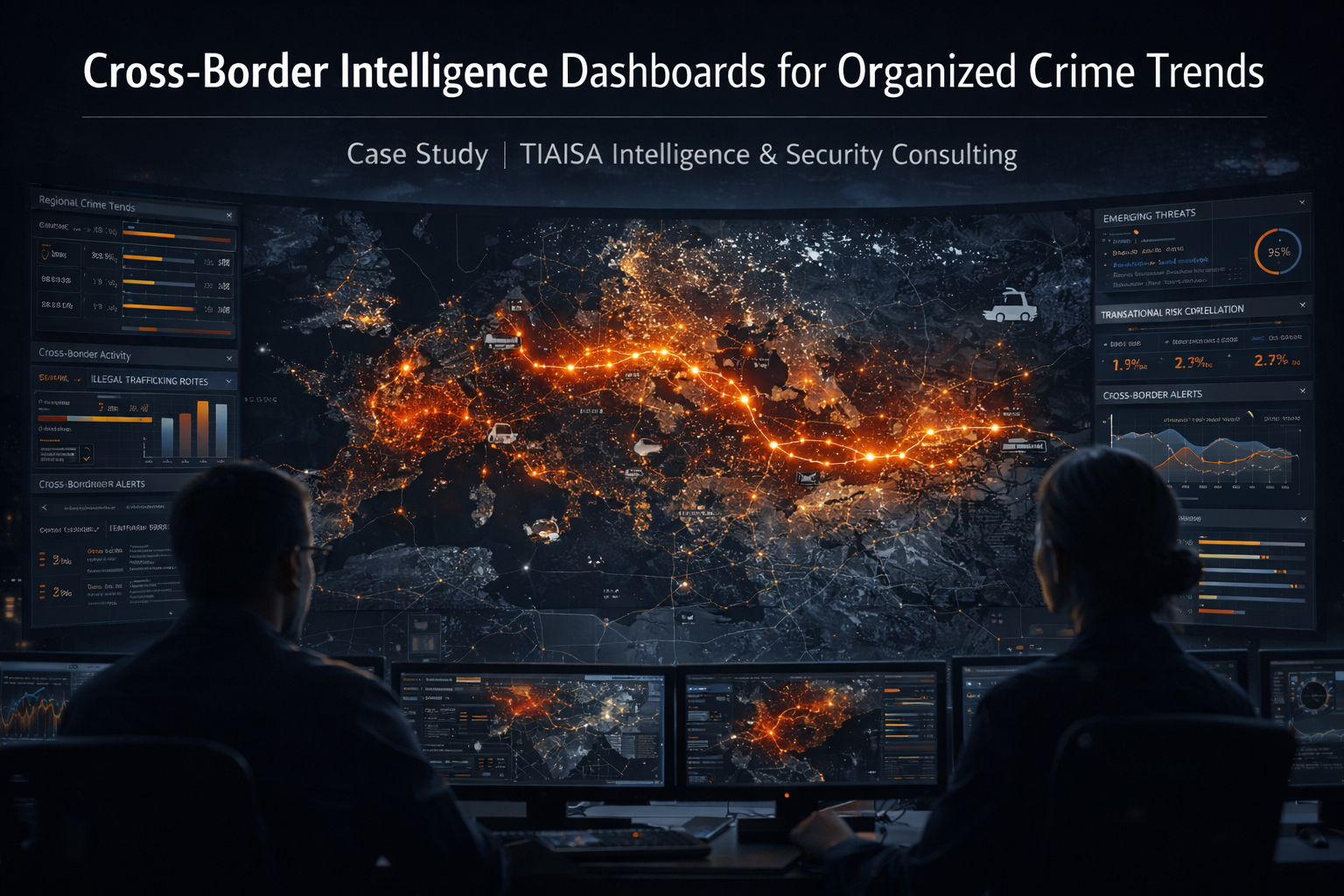
Case Study | TIAISA Intelligence & Security Consulting
Overview
Modern organized crime operates across borders, exploiting regulatory gaps, jurisdictional limitations, and fragmented intelligence systems. Information is often scattered across agencies, regions, and formats, making it difficult for decision-makers to perceive emerging transnational patterns.
This case study illustrates how cross-border intelligence dashboards, powered by data fusion and AI analytics, can strengthen situational awareness and strategic coordination against organized criminal activity.
All information in this case study is anonymised and presented for intelligence illustration only.
The Challenge
An institution monitoring regional security trends faced persistent challenges related to:
- Disconnected intelligence sources across jurisdictions
- Limited visibility into transnational criminal movement patterns
- Delayed identification of emerging cross-border risks
- Overdependence on narrative reporting rather than data-driven insight
Decision-makers required a centralised, interpretable intelligence view.
Intelligence Objective
The primary objective was to develop a multi-jurisdictional intelligence visualization framework capable of:
- Aggregating regional security indicators
- Identifying cross-border movement trends
- Highlighting emerging criminal corridors
- Supporting coordinated strategic planning
The framework was designed for analytical and advisory use only.
TIAISA Intelligence Framework Applied
TIAISA deployed a structured intelligence fusion methodology, integrating multiple analytical layers.
1. Multi-Source Intelligence Integration
Inputs were consolidated from:
- Open-source intelligence (OSINT)
- Public security bulletins
- Regional crime trend reports
- Economic and mobility indicators
All data sources complied with applicable legal and governance standards.
2. Geospatial & Temporal Mapping
Geospatial and time-series modeling was applied to:
- Visualize cross-border movement flows
- Identify recurring transit corridors
- Detect seasonal and cyclical risk patterns
This enabled longitudinal trend analysis rather than incident tracking.
3. AI-Assisted Pattern Detection
Machine learning models were used to:
- Detect anomalies in movement and activity trends
- Highlight emerging clusters
- Prioritize signals requiring human analyst review
Human oversight remained central throughout.
Key Findings
The dashboard analysis revealed:
- Previously unrecognized cross-border corridors connecting multiple regions
- Seasonal shifts in organized crime activity patterns
- Adaptive rerouting following enforcement or policy changes
- Structural dependencies between regional networks
These patterns were not apparent within single-jurisdiction datasets.
Deliverables Provided
TIAISA delivered institutional-grade intelligence products, including:
- Interactive Cross-Border Dashboards
- Trend Analysis Reports
- Regional Risk Comparison Models
- Strategic Coordination Briefings
All outputs were optimized for leadership-level interpretation.
Strategic Impact
The intelligence framework enabled stakeholders to:
- Improve regional coordination
- Anticipate transnational risk migration
- Allocate analytical resources more efficiently
- Strengthen inter-agency communication
The result was enhanced strategic alignment and foresight.
Why This Matters
Transnational crime succeeds where information is fragmented.
Integrated intelligence dashboards allow institutions to:
- See beyond borders
- Detect early structural shifts
- Respond strategically rather than locally
This case demonstrates the value of regional intelligence integration.
Compliance & Ethics Note
TIAISA provides analytical and advisory intelligence services only.
This case study does not describe surveillance operations, enforcement actions, or tactical interventions.
All methodologies adhered to legal and ethical governance standards.
Leave a Reply